


Recently, the volume of the headlines has increased.
- War in the Middle East
- Oil prices approaching $100 per barrel
- Questions around whether AI-related spending has outpaced fundamentals
- Concerns that parts of the technology sector may have moved too far, too quickly
Some of these risks are legitimate. Others may resolve over time.
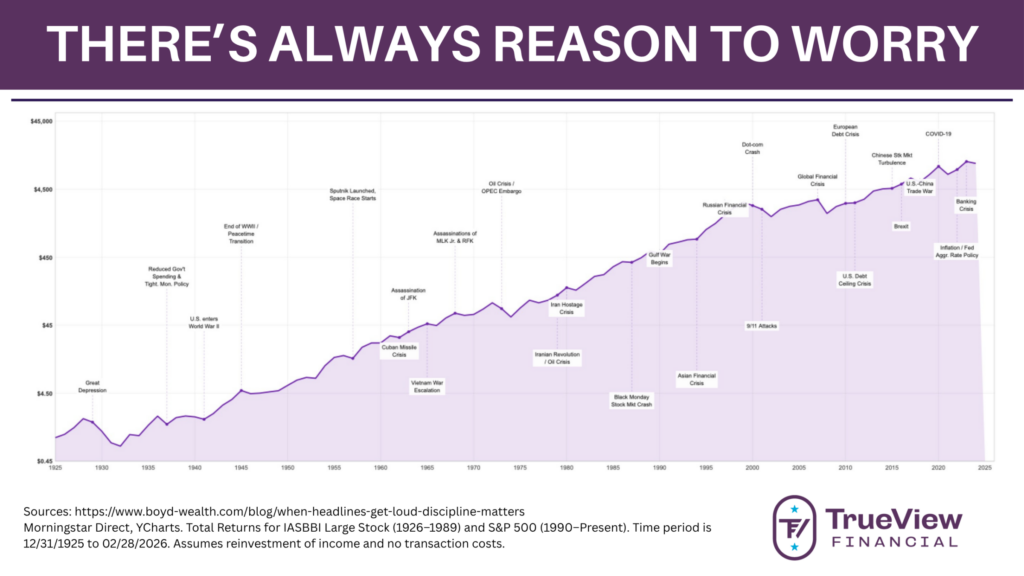
In the moment, however, headlines like these can make the future feel more uncertain than it may ultimately be. If you have invested through multiple market cycles, you have likely seen this pattern before.
Each year seems to bring a new reason for concern.
THE BEHAVIOR GAP
One of the more consistent findings in investment research is what is referred to as the behavior gap.
Investors often allocate more capital following periods of strong performance and reduce exposure during periods of uncertainty or market stress. Over time, those decisions can create a gap between the returns investments generate and the returns investors actually experience.
MIND THE GAP
Morningstar has studied this concept for years through its “Mind the Gap” research. Their analysis compares the returns produced by U.S. mutual funds and exchange traded funds with the returns experienced by investors.
The difference is often driven by timing.
Morningstar estimates that this gap has historically cost investors approximately 1.2 percent per year.¹
When translated into dollar terms, the impact becomes more tangible. A $1,000,000 portfolio growing at a 7 percent annual investor return would reach $1,967,151 over a 10 year period. At an 8.2 percent investment return, that same portfolio would grow to $2,199,239.
That represents a difference of $232,088.
Over longer timeframes, this difference can become significantly larger.
*The figures above are hypothetical and for educational purposes only. They do not reflect the performance of any specific investment or strategy. Actual investor results will vary and may be materially different. Past performance is not indicative of future results. Morningstar is an independent investment research firm. The research cited reflects their historical analysis.
ADVISORS ARE HUMAN TOO
There is an important point that is not always discussed.
Advisors are subject to many of the same behavioral pressures.
We see the same headlines. We experience the same uncertainty. The distinction is not the absence of emotion. It is the presence of a disciplined framework designed to guide decision making.
Research in behavioral finance has shown that professionals can fall into similar patterns, including overconfidence, reacting to short term developments, and trading too frequently.
This raises a practical question. If these pressures affect everyone, what differentiates one advisor from another?
TEMPERAMENT
In many cases, the difference comes down to temperament rather than intelligence.
Long term investment outcomes are rarely driven by correctly predicting short term market movements. Instead, they are influenced by the ability to maintain discipline during periods of uncertainty.
That includes following a repeatable process rather than reacting to headlines. It includes evaluating data rather than responding to fear.
It also requires recognizing that periods like this are a normal part of investing.
THIS IS PART OF THE PROCESS
Each year brings a different set of concerns.
- At times, it is inflation
- At other times, it is geopolitical tension
- It may also be interest rates, technology valuations, or recession concerns
While the specific headlines change, the underlying emotional cycle tends to remain consistent.
Periods of uncertainty are not a flaw in financial markets. They are a characteristic of how markets function. Risk and return are connected, and periods of discomfort often coincide with increased uncertainty.
These periods can be challenging, but they are not unusual.
WHY PROCESS MATTERS
Our approach is grounded in a disciplined, data driven process.
We have experienced multiple market cycles over time. While each environment has unique elements, several principles remain consistent:
- Maintain diversification
- Avoid decisions driven by short term emotion
- Make adjustments thoughtfully when supported by data
Clients do not often ask how we invest personally, but we follow the same general principles.
The discipline required for long term investing applies broadly.
PERSPECTIVE
The headlines may continue. They often do.
Market volatility may increase from current levels. That is always a possibility. However, environments like this are not new.
Investing has historically required patience during periods of uncertainty. That remains true today.
If you would like to review your portfolio or financial plan, please feel free to reach out.
-James DesRocher
¹ Source: Morningstar, 10 Year Period Ending 12/31/2024
https://www.morningstar.com/funds/investors-still-need-mind-gap-their-funds-returns
https://www.boyd-wealth.com/blog/when-headlines-get-loud-discipline-matters
***
Past performance is not a guarantee of future results. Indices are unmanaged, and one cannot invest directly in an index. All investments contain risk and may lose value.
Hypothetical examples have inherent limitations and are not designed to reflect actual trading or investment results. No representation is being made that any investor will achieve similar outcomes. This chart is for illustrative purposes only and is not intended to suggest a particular course of action or represent the performance of any particular financial product or security.
8866246.1 Exp 04/28